
The particular flavour of Monastrell grapes offers the advantage that they may be used for different purposes: they may be used for food, as also for the making of wines of very good quality.
This type of grape is one of the very well-known varieties of Spanish origin; it may be found in Yecla, Alicante, the Balearic Islands and Jumilla, which becomes a reference, as its cultivation currently represents 80 % of the whole cultivated surface.
The name Monastrell is how it is called in Spain; in France it is called Mourvedre and in Portugal it is known by the name of Mátaro.
Description of the Monastrell grape:
Monastrell is a type of red grape of late ripening. The plants of Monastrell grapes offer strong bushes that give an excellent growth of the shoots, which ripen completely.
The leaves themselves are trilobate and have a slight dissection. The berries are circular, small, of a dark purple tone, and offer a waxy bloom. The skin of the grape is hard with a quite juicy flesh.
The bunches are conical, dense and of average size; the Monastrell method ripens after 150 days from the beginning of bud movement.
Advantages of Monastrell grapes:
The growers of the Monastrell grape know perfectly the advantages of this type of grape, such as:
- It has a high productivity.
- They are not very demanding as to types of soils.
- It is a grape that is resistant to drought.
- It offers a wine of very good quality.
It possesses few (disadvantages), such as:
- It develops very slowly in humid, cold climates.
- It is not very resistant against fungal diseases.
In what season may it be planted?:
The growers of Monastrell grapes habitually carry out the planting in the season of autumn or spring.
In the spring season the soil is more humid and contains more useful components, so that the seedling begins to form roots and starts its development.
Although this possesses a disadvantage: in spring the plant has more possibilities of being infected by pests.
Planting in the autumn season must be carried out well in advance so that the plant possesses sufficient time to create the necessary roots. When the winter season arrives, the plants of Monastrell grape must be protected, so that freezing will be avoided.
Preparation for planting:
To prepare the land for planting, one begins by creating holes in which the combination of ash, sand and other nutritional components will be placed. To carry out the planting in the spring stage, one must begin in the autumn season.
The cuttings must be soaked with water, so as to stimulate growth, and afterwards the seeds of Monastrell grapes are planted in plastic containers.
The seedling:
The process of planting the seedling in a determined area: it must be placed in a trench or hole already prepared with a little earth with nutrients, and the neck of the plant left in the open air.
Caring for the Monastrell grape:
The Monastrell variety can develop independently, but care must be taken so that the yield increases and the berries improve in quality.
The watering of the grape is simple, as they tolerate heat; watering is carried out according to atmospheric conditions.
In the first 12 months one must water once a week, and during the heat phase one must moisten every day. Five buckets of water per adult plant are recommended.
Finally, the grapes must not be watered in the flowering stage and watering should be stopped for 2 weeks before the berries are ripe. The last watering is at the end of the autumn season, immediately after the fall of the foliage.
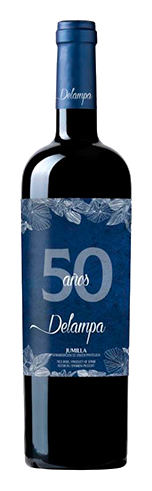
Discover here our wine of Delampa Monastrell and delight in the Monastrell grape in all its splendour. At Bodegas Delampa the wines are made directly in our cellars since 1921, flavour and tradition that captivate the senses.